



Close Protection Driver in Spain: Secure Executive Travel
Travelling as a high-profile principal in Spain calls for more than a well-dressed driver and a clean car. It calls for someone trained to read a threat before it becomes one. That is the gap a close protection driver in Spain fills. It’s why corporate travel managers, security consultants, and private families now ask for this service by name, rather than booking a generic hire car.
What Is a Close Protection Driver in Spain (and How Is It Different From a Chauffeur)?
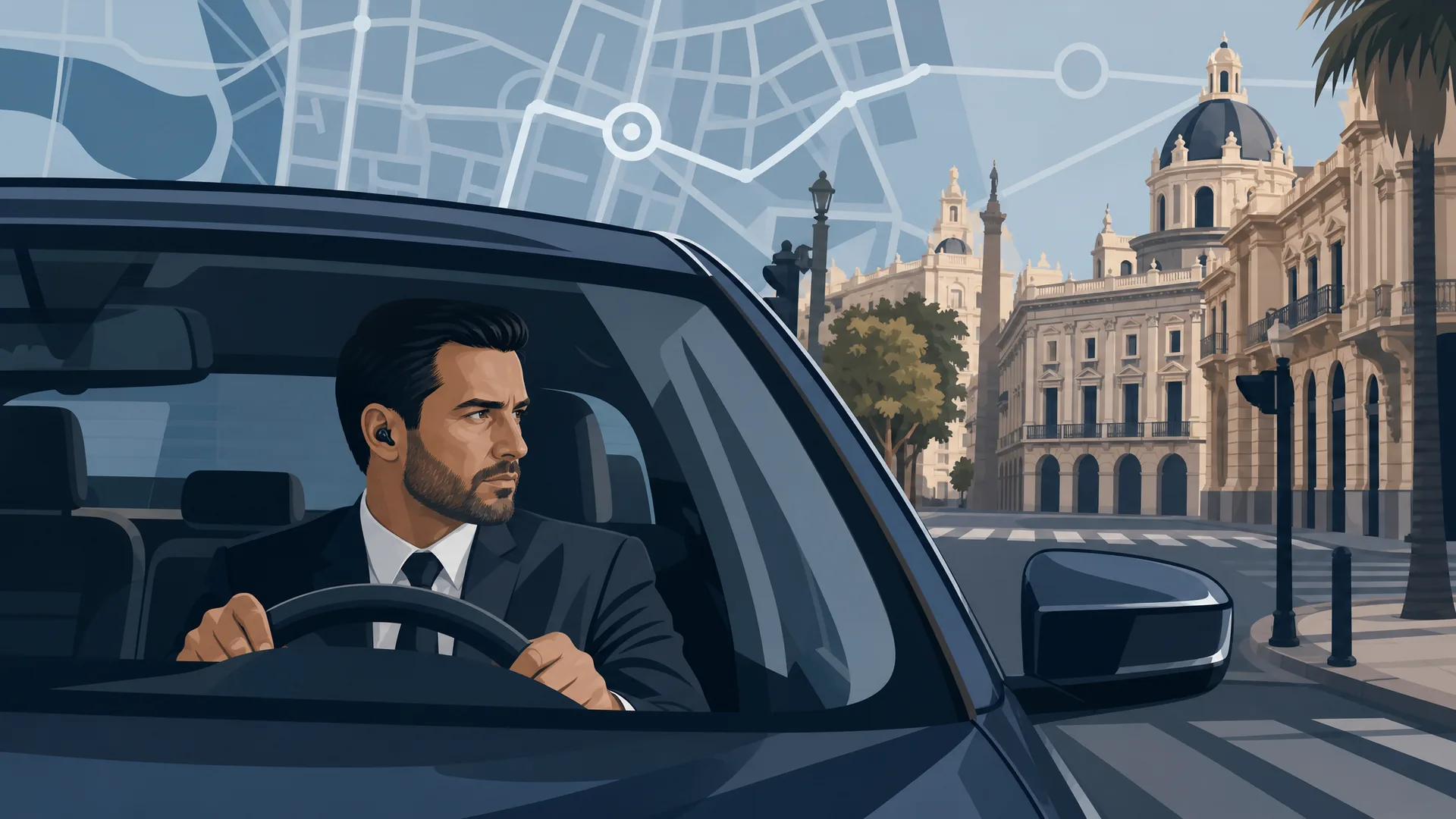
A close protection driver in Spain is a chauffeur who also holds formal personal-security training. This person plans routes, watches for surveillance, and reacts to threats. They do this while driving to the same executive standard clients expect from a luxury car service.
A close protection chauffeur in Spain is not simply a bodyguard who happens to drive. The role merges two disciplines usually kept apart: professional chauffeuring and close protection officer (CPO) work. That combination matters because most incidents involving a principal happen during transit, not while they’re seated in a boardroom or hotel suite.
Close Protection Chauffeur vs. Standard Executive Driver
A standard executive driver focuses on comfort, punctuality, and smooth handling of the vehicle. That is the job, and most reputable chauffeur services do it well.
A close protection driver does all of that, plus route security, situational awareness, and emergency response. They assess a hotel drop-off point before arrival. They vary timings and routes. They know how to move a principal away from a developing situation quickly and calmly. The vehicle is the same class of car. The driver’s training and mindset are what change.
CPO Qualifications and Training Standards Behind Every Secure Chauffeur Service in Spain
Any secure chauffeur service worth booking in Spain should explain, plainly, what training its drivers hold. Vague reassurances aren’t enough when the client’s safety is the product.
Close protection training in Europe generally combines two strands. The first is defensive and evasive driving: skid control, controlled braking, and manoeuvres to break away from a following vehicle. The second is formal bodyguard or CPO certification covering threat recognition, protective escort procedure, and communication under pressure. A properly qualified CPO driver in Spain has been assessed on both, not just one.
Vetting matters as much as training. Clients booking a close protection officer driver should expect background checks, confidentiality agreements, and a track record with comparable clients, whether that’s a listed company’s board members or a family with a public profile.
What a Close Protection Officer Driver Is Trained to Do
A close protection officer driver plans a journey before it starts, not just steers the car once it does. That includes checking arrival and departure points, identifying choke points along a route, and agreeing a fallback plan with the client’s security team, if one exists.
Behind the wheel, the training covers safe following distances, reading traffic for anomalies, and executing evasive manoeuvres when the situation calls for it. Off the road, it covers discretion, professional conduct around press or public attention, and calm handling of unplanned changes to schedule. Clients who want to understand the baseline expected of any professional driver in this market can look at the professional chauffeur standards clients should expect before layering on the additional CPO requirements.
Secure Route Planning and Anti-Surveillance Driving Across Spain
Route planning is where a close protection driver earns their fee before the client ever gets in the car. It starts with a threat assessment: who is travelling, why, and what is known about the risk level for this specific trip.
Anti-surveillance driving in Spain means building unpredictability into an otherwise ordinary journey. That can mean varying departure times, choosing between two or three viable routes rather than always taking the fastest one, and briefly changing speed or lane position to see whether another vehicle mirrors the move. None of this needs to look dramatic. Done well, it’s invisible to everyone except the driver watching for it.
Threat Assessment and Pre-Trip Intelligence in Madrid and Beyond
Madrid presents its own logistics: dense city traffic, high-profile hotels and government buildings, and airport transfers that pass through predictable corridors. A close protection driver working in the capital builds pre-trip intelligence around these fixed points. They check for roadworks, planned demonstrations, or events that could create bottlenecks or forced stops.
For clients whose itinerary centres on the capital, the same standards apply across every leg of the trip, from airport pickup to evening events. This is the core of the close protection driver services in Madrid that corporate clients and visiting principals rely on most. Spanish-speaking clients or teams coordinating locally can find the same information via the servicio de chófer con protección CPO en Madrid.
Beyond Madrid, the same principles extend to routes between cities. A family or executive moving between Barcelona and the capital benefits from a driver who treats the whole journey, not just the city legs, as part of the security plan. This is covered under the private chauffeur service between Barcelona and Madrid.
Discretion and Profile Management for High-Net-Worth and Corporate Clients
Discretion is not a marketing word here. It’s a working requirement. For high-net-worth families and corporate principals, being noticed is often the risk itself. So the driver’s job includes managing how visible the client is at every stage of a trip.
In practice, this means a vehicle that doesn’t draw attention. It means drivers who don’t discuss client movements or itineraries with anyone outside the security circle, and pickup points chosen to avoid crowds, cameras, or waiting press. It also means staff who know when to stay silent, when to step forward, and when to simply blend into a hotel lobby or corporate lobby without being asked twice.
Reputation management is part of this too. A poorly handled arrival, or a driver who lingers too long at a public entrance, can create the exact kind of attention a client was trying to avoid. Corporate travel managers who need this same standard of discretion for board members or executives without a formal protection requirement will find it reflected in the discreet driver service for business travel.
Fleet Vehicles and Armoured Options Suited to Close Protection Roles in Spain
Spain Chauffeur’s close protection service pairs CPO-qualified drivers with a fleet centred on the Mercedes-Benz E-Class. Clients get discreet, executive-grade security transport, not a repurposed taxi or generic hire car. The E-Class works well for this role because it presents as a standard executive vehicle. It doesn’t signal “security detail” the way an armoured SUV convoy might, which supports the discretion goal described above.
For clients who want the same vehicle standard without the security layer, the wider luxury car with driver services covers business travel, airport transfers, and events across Spain.
When to Consider an Armoured Car Service
An armoured car service in Spain is not the right fit for every close protection booking. A standard executive vehicle driven by a CPO-qualified chauffeur serves most corporate and HNW travel well, because the driver’s training and route planning address the majority of realistic risks.
Armoured vehicles become relevant when a client’s threat profile is elevated: a specific, credible threat, a role that draws sustained public hostility, or a government or diplomatic requirement for hardened transport. In those cases, an armoured vehicle should sit alongside, not replace, the same standard of driver vetting and route planning already described. Clients unsure which category they fall into should raise it directly during the consultation stage, before booking a vehicle.
Common Scenarios: Corporate Principals, HNW Families, and Visiting Dignitaries
A visiting corporate principal flying into Madrid for a week of investor meetings needs a driver vetted for both defensive driving and route security, not a separate bodyguard and a separate chauffeur working around each other. One CPO-qualified driver covering the full week reduces handoffs and keeps route knowledge consistent across every meeting and hotel transfer.
High-net-worth families touring Spain over several cities benefit from a single CPO driver who maintains continuity of threat awareness across Madrid, Barcelona, and coastal routes, rather than switching providers city to city. The driver who planned the Madrid airport pickup is the same one who understands the family’s routine three cities later. That matters more than it might sound.
Visiting dignitaries and their staff typically arrive with fixed protocol requirements: specific arrival points, agreed timings, and coordination with local security or embassy staff. A close protection driver in Spain who has handled this kind of trip before can slot into that protocol without needing it explained from scratch.
How to Book a CPO-Qualified Chauffeur in Madrid and Across Spain
Booking starts with a short consultation covering the traveller’s itinerary, the cities involved, and any known threat considerations. From there, the service confirms vehicle choice, driver assignment, and route planning ahead of the trip.
Corporate travel managers arranging recurring executive travel can also route this through the standard private chauffeur for business travel in Spain booking process, with the close protection element added as a requirement.
Clients planning travel in the capital, or across multiple Spanish cities, are best served by requesting a quote early. This gives the team time to complete threat assessment, route planning, and driver assignment before the trip begins, rather than compressing that work into the days right before arrival.