



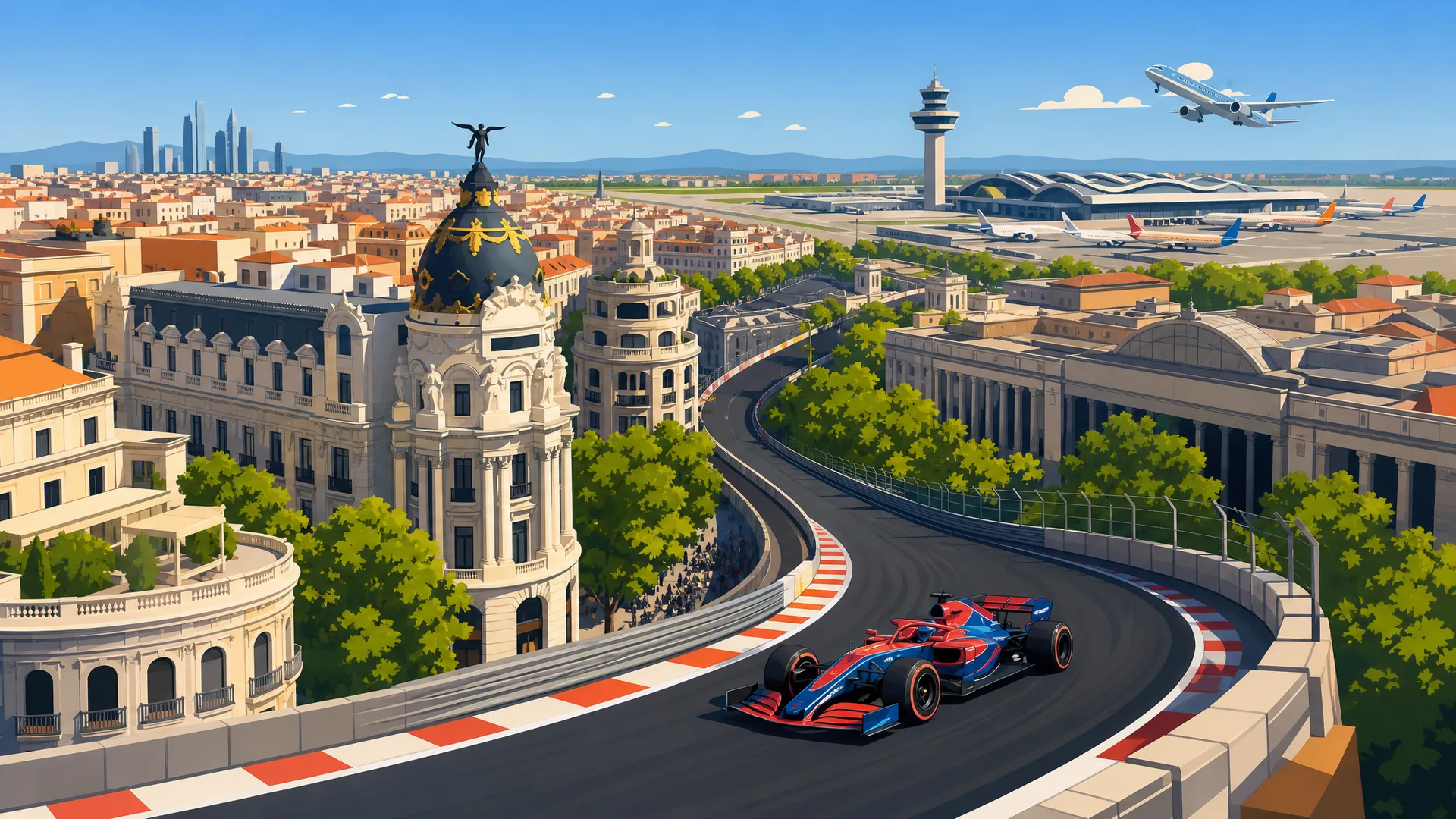
Formula 1 Madrid Guide: Tickets, Access & Accommodation
Formula 1 Madrid marks the arrival of a new Grand Prix on the world championship calendar, and it’s already one of the most talked-about additions to Spanish motorsport. For visitors used to the long-standing Circuit de Barcelona-Catalunya, a street-style circuit in the capital changes the entire logistics picture: where to fly in, where to stay, how to get trackside without losing hours to traffic. This guide walks through what to expect from Formula 1 Madrid, and how experienced visitors plan their travel around race weekend.
What Is Formula 1 Madrid and When Does It Take Place
Formula 1 Madrid is the Spanish capital’s own round of the F1 World Championship, joining the calendar alongside the sport’s more established European stops. Race organisers typically slot it into the busy European leg of the season, so travellers should expect race weekend to fall during the warmer months, though exact dates can shift from year to year as the calendar is finalised. Anyone planning a trip should treat published dates as provisional until F1 and the local organisers confirm the final schedule.
Why Madrid Was Chosen to Host a Grand Prix
Madrid’s selection reflects the city’s growing role as a global business and events hub, along with its strong air connectivity and hospitality infrastructure. The Spanish capital already draws large international conferences and trade fairs, so hosting a Grand Prix builds on existing experience managing high-volume visitor traffic. It also gives F1 a second Spanish venue, expanding the sport’s footprint in one of its most loyal fan markets.
Circuit Location and Venue Details
The circuit concept centres on the area around the IFEMA Madrid exhibition complex, expected to serve as the operational hub for race weekend. IFEMA has long hosted major international events, so the venue already has experience managing large crowds, security perimeters, and transport flows. The purpose-built street circuit layout around this district means access roads, parking, and shuttle points will likely be concentrated near IFEMA rather than spread across the wider city.
Getting to Formula 1 Madrid: Airport and City Logistics
Most international visitors arrive through Madrid-Barajas, so understanding that first leg of the journey matters as much as knowing the circuit layout itself.
Arriving via Madrid-Barajas Airport
Madrid-Barajas Adolfo Suárez Airport is one of the busiest hubs in Europe. Race weekends at other F1 host cities have historically shown sharp spikes in airport and hotel congestion in the 48 hours before the event, and that pattern is worth planning around. Travellers landing in the days immediately before a Grand Prix should expect longer queues at taxi ranks, tighter availability of rideshare vehicles, and unpredictable pricing. Booking a fixed-price private airport transfer in Madrid ahead of time removes that uncertainty, since the vehicle and driver are confirmed regardless of how busy the terminal gets. For a closer look at how this leg of the trip typically works, the private car service from Barajas airport is designed specifically around this kind of high-demand arrival window.
Getting from Your Hotel to the Circuit
Once in the city, the second logistical challenge is reaching the circuit itself on race day. With the venue concentrated around IFEMA, road closures and pedestrian-only zones are likely near the site, and public transport stations serving the area will see far heavier use than usual. Spain Chauffeur’s Madrid-based fleet and chauffeurs already handle high-profile corporate and VIP clients across the city, which gives first-hand insight into which routes and pick-up points tend to get congested during major events. That local knowledge becomes especially useful on a Grand Prix weekend, when standard routes to the venue may be diverted or closed entirely.
VIP and Hospitality Experiences at the Madrid Grand Prix
Formula 1 events are known for tiered hospitality, and Madrid is expected to follow the same general structure seen at other Grands Prix.
Paddock Club and Premium Grandstand Options
At most F1 venues, the top tier of hospitality is the Paddock Club: close proximity to the pit lane, curated dining, and access to areas ordinary ticket holders don’t reach. Below that sit premium grandstand seats, which trade some of the exclusivity of the Paddock Club for excellent sightlines at a lower price point. Trackside lounges and hospitality suites typically fill the space between these two tiers, giving fans a range of options depending on budget and how much access they want beyond simply watching the race.
Executive and Corporate Hospitality Packages
Corporate clients attending Formula 1 Madrid often combine hospitality tickets with organised transport, since arriving as a group creates its own logistical demands. Executives hosting clients or sponsors tend to bundle their hospitality package with private ground transport, so guests move from hotel to circuit without the group splitting up or getting stuck in event traffic. This is also where corporate transport services in Madrid become relevant, particularly for companies bringing delegations of clients or partners to the race as part of a broader hospitality programme.
Where to Stay for Formula 1 Madrid
Accommodation strategy for Formula 1 Madrid comes down to a trade-off between proximity to the circuit and access to the rest of the city.
Hotels Near the Circuit vs. Central Madrid
Hotels close to the IFEMA area offer the shortest possible journey to the circuit on race day, which appeals to visitors who want to minimise travel time and avoid event-day traffic altogether. Central Madrid hotels, by contrast, sit further from the venue but put guests closer to the city’s restaurants, shopping, and cultural sites. For visitors treating the Grand Prix as one part of a longer trip, a central base often makes more practical sense, even if it means a longer transfer on race day itself.
Balancing Convenience with City Access
The right choice depends on how visitors plan to spend their time outside race sessions. A hotel near the circuit suits those focused purely on the racing, while a central Madrid property with a reliable chauffeur on call gives guests both easy circuit access on race day and unrestricted movement around the city the rest of the time. This is where pre-arranged private transport pays off, since it removes the need to choose between convenience and location.
Chauffeur-Driven Transport for Formula 1 Madrid Race Weekend
Race weekend traffic, security perimeters, and unpredictable demand for taxis all make ground transport one of the most important details to sort out before arriving in Madrid.
Private Transfers to the Circuit
Chauffeur operators in established F1 host cities such as Monaco, Silverstone, and Abu Dhabi consistently advise pre-booking fixed-price transfers well ahead of race week. Taxi and rideshare availability tightens sharply as the event approaches, and prices tend to surge accordingly. Madrid is likely to follow the same pattern once the Grand Prix becomes an annual fixture. A pre-booked chauffeur service locks in both the price and the pick-up time, so visitors aren’t left negotiating with limited local supply during the busiest hours of the weekend.
Security-Conscious Travel for High-Profile Attendees
Formula 1 weekends attract a mix of team guests, sponsors, celebrities, and executives, many of whom need a level of discretion that standard taxis or rideshares can’t offer. Discreet VIP transport for high-profile clients addresses this directly, with vetted drivers and vehicles suited to attendees who prefer to avoid public attention. For attendees with heightened security requirements, close protection security transport in Madrid extends that same discretion with trained personnel, giving clients a coordinated travel plan rather than a series of ad hoc bookings. Together, these services form the backbone of a well-organised Formula 1 Madrid itinerary, and they tie into the wider executive VIP limo service guide for Madrid that covers chauffeur options across the city more broadly.
Beyond the Track: Sightseeing and Madrid Highlights for F1 Visitors
Race weekend rarely fills an entire trip, and many visitors extend their stay to take in the rest of what Madrid has to offer.
Extending Your Trip with Private Guided Tours
Madrid’s museums, historic quarters, and dining scene reward the extra day or two that many Formula 1 Madrid visitors add to their trip. Private VIP sightseeing tours in Madrid let visitors structure that time efficiently, pairing a knowledgeable guide with a chauffeured vehicle so the day isn’t lost to public transport or traffic. For anyone combining race weekend with a broader visit to Spain’s capital, that kind of planned, private itinerary tends to make the difference between a rushed stopover and a trip worth repeating.
Formula 1 Madrid brings together motorsport, business travel, and city tourism in a way few other events on the Spanish calendar can match. Booking transport early, whether for the airport run, circuit access, or sightseeing between sessions, remains the simplest way to keep the weekend running smoothly from the moment you land to the moment you head home.