



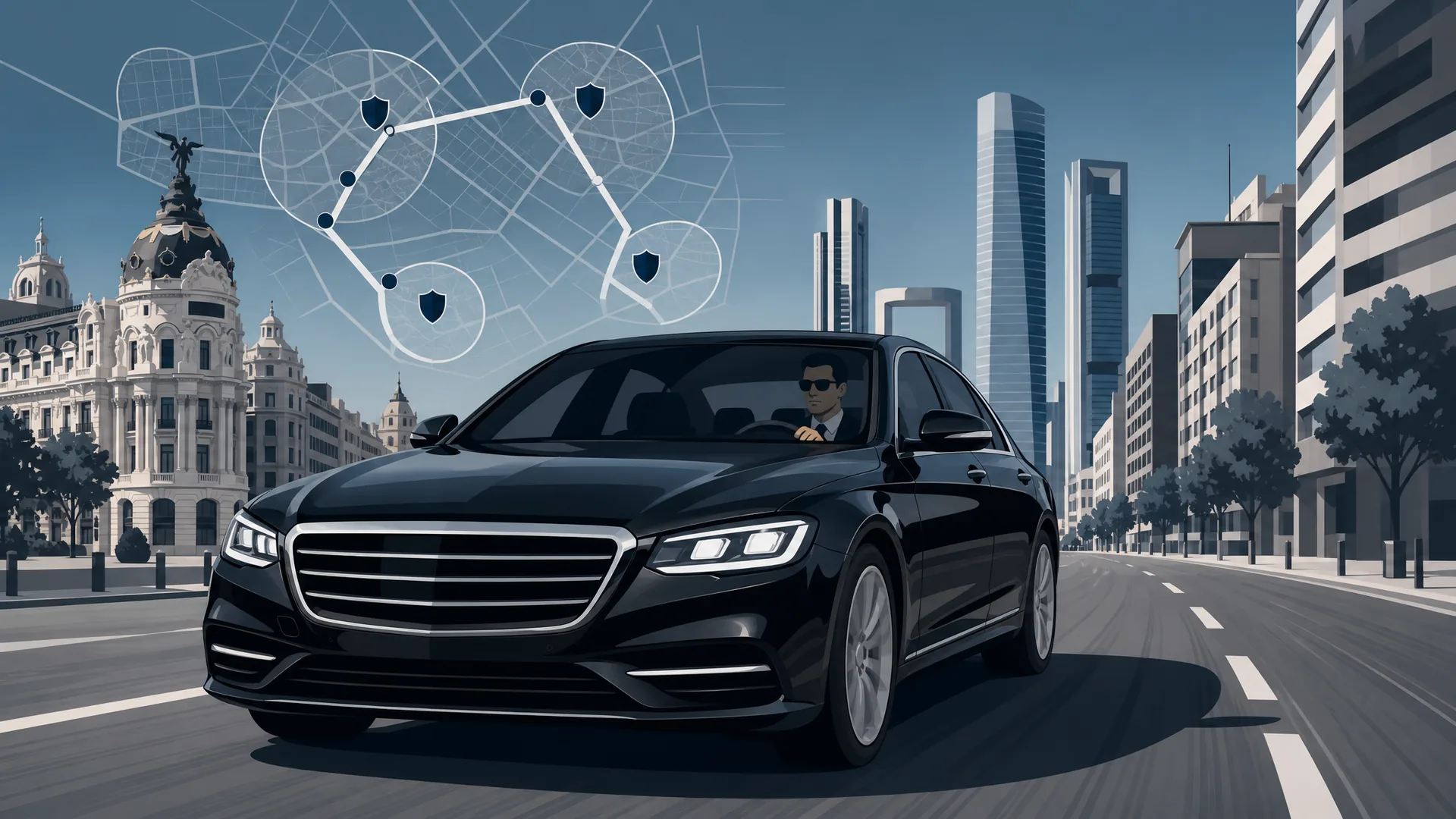
Secure Transport High-Profile Clients Madrid
Secure transport for high-profile clients in Madrid is a specialised discipline, not a premium add-on to a standard chauffeur booking. It combines vetted drivers, defensive driving skills, and route planning built around a single objective: getting a dignitary, executive, or public figure from one point to another without incident or unwanted attention. For clients whose safety, schedule, or reputation depends on getting this right, understanding what actually sits behind the service matters as much as choosing the vehicle.
What Secure VIP Transport in Madrid Really Means
Secure VIP transport is ground transport built around risk management rather than comfort alone. A standard chauffeur service focuses on punctuality, presentation, and a smooth ride. Secure transport adds a layer of protocol: driver vetting, route reconnaissance, contingency planning, and often direct coordination with a client’s own security team. The vehicle and the driver are still central, but so is everything that happens before the client ever gets in the car.
Secure transport for high-profile clients in Madrid sits in a niche corner of the ground transport market. Few providers can show the vetting depth, training, and discretion that dignitaries, corporate leadership, and public figures require.
Who Needs Dignitary and Executive Security Transport
Demand for this kind of service clusters around a few recognisable groups. Diplomats and government officials visiting Madrid for bilateral meetings or summits need transport that aligns with formal protocol and security requirements. Corporate executives, particularly those attending board meetings, M&A negotiations, or shareholder events, often need discretion around their schedule and movements. Public figures, entertainers, athletes, media personalities, need protection from physical risk and from unwanted public exposure. Event organisers running award ceremonies, product launches, or diplomatic receptions also book this kind of transport on behalf of their guests.
Security Vetting: How Drivers Are Screened for Protected Client Transport
Trust in protected client transport starts with who is behind the wheel. A driver assigned to this kind of work carries responsibility that goes well beyond navigation and timekeeping. For the duration of the journey, they’re effectively an extension of the client’s security perimeter.
Spain Chauffeur’s close protection (CPO) service pairs vetted security-trained drivers with a Mercedes-Benz E-Class fleet maintained to executive protection standards. That pairing of vetted personnel with a consistent, well-maintained fleet is the baseline any client should expect before booking secure transport in Madrid.
Background Checks and Ongoing Vetting
Vetting for this kind of role is not a one-time formality. It typically includes background checks covering criminal history, driving record, and professional references, followed by periodic re-checks rather than a single approval at hiring. Spain Chauffeur drivers assigned to secure transport bookings undergo vetting and coordination briefings before each engagement, aligning with client security teams’ protocols. The driver isn’t cleared once and forgotten. They’re briefed specifically for the client, the route, and the sensitivities of that particular assignment.
Training Standards Behind Executive Security Transport
Executive security transport depends on drivers who can operate calmly under pressure and integrate smoothly with a client’s existing security arrangement. This is where the gap between a good chauffeur and a security-trained driver becomes obvious.
Close Protection Officer (CPO) Coordination
When a client travels with their own close protection officer, the driver’s role shifts. They need to take direction from the CPO in real time, understand hand signals and radio protocols, and adjust routing or timing on request without hesitation. Drivers trained for this environment know where their responsibilities end and the CPO’s begin, which avoids confusion during a live movement. For a closer look at how this training is structured, see the CPO driver training standards in Spain.
Defensive Driving and Emergency Response
Defensive driving training covers evasive manoeuvres, hazard recognition, and controlled response to unexpected obstructions, skills rarely needed but critical when they are. Drivers are also trained in emergency response basics: what to do if a route is compromised, how to communicate with the security team, and how to keep a vehicle moving safely under stress. This training separates executive security transport from a standard high-end car service, where such scenarios are never part of the driver’s brief.
Risk Management and Route Planning for Dignitary Transport in Madrid
Good outcomes in dignitary transport in Madrid are decided long before the client steps into the vehicle. Risk management here is proactive rather than reactive.
Advance Route Reconnaissance
Advance route reconnaissance means physically checking the intended route ahead of the movement: timing it at the relevant hour, identifying choke points, confirming venue access and drop-off logistics, and noting anything unusual. Close protection professionals typically say route reconnaissance and advance planning reduce exposure more than reactive measures during the transport itself. In practice, that means most of the security work happens on paper and on the ground before the client arrives.
Contingency and Alternate Routing
No single route plan is treated as final. Alternate routing is prepared in case of traffic incidents, road closures, or unplanned crowds, and drivers are briefed on these options before departure. Coordination with venue security, confirming entry points, arrival windows, and hold areas, is built into the plan rather than improvised on arrival. Executive protection tends to be requested most heavily around high-visibility events such as state visits, major conferences, and red-carpet occasions, where a public figure’s schedule is published in advance and known to more than just their own team. Dignitaries and corporate executives visiting Madrid for summits, award ceremonies, or major events like Formula 1 Madrid often need this level of route planning and discreet arrival protocol rather than a standard chauffeur pickup.
Discrete Operations: Keeping High-Profile Movements Low-Profile
Discretion is arguably the defining feature of this service. A high-profile client’s safety often depends less on visible security and more on simply not being noticed.
Unmarked, understated vehicles are part of that approach. A dark, well-maintained sedan attracts far less attention than a branded car or an obvious convoy. This is one reason a low-key vehicle choice, like the Mercedes E-Class chauffeur fleet, is standard for this kind of work rather than a larger or more conspicuous vehicle.
Confidentiality agreements covering the driver and any support staff are standard practice, and awareness of a booking’s details is kept to the smallest group necessary, often just the assigned driver and a single point of contact. Itineraries, guest names, and pickup points are shared on a need-to-know basis rather than circulated through a wider booking system. For clients whose visibility itself is the risk factor, this operational discretion matters as much as the driver’s training. Those planning appearances or travel that requires this level of discretion may also want to review discreet VIP transport for celebrities in Madrid for related considerations around public exposure.
Choosing a Trusted Secure VIP Transport Provider in Spain
Reputation is difficult to fake in this niche. Clients who need secure VIP transport in Spain tend to rely on referrals from security consultants, corporate travel managers, or previous clients rather than online reviews alone. A provider’s track record with recurring corporate or diplomatic bookings is usually a stronger signal than marketing claims.
Questions to Ask Before Booking
Before booking, clients or their security teams should ask a few direct questions. How are drivers vetted, and is that vetting ongoing or a one-time check? What training do drivers receive for coordinating with an external close protection officer? How far in advance is route reconnaissance conducted, and does the provider build in contingency routing as standard? What confidentiality measures apply to booking details and driver briefings? How far in advance should a booking be made for a high-visibility event? For major summits or events, several weeks’ notice allows time for proper route reconnaissance and coordination with the client’s security team, though shorter-notice bookings can often still be accommodated depending on the scope of the movement.
Executives comparing this level of service against a general premium booking may find it useful to review a VIP driver service guide for executives, or to look at how secure transport fits within broader corporate transport services in Madrid. For a wider view of what’s available across the country, the full range of chauffeur service options in Spain provides useful context.
For dignitaries, executives, and public figures whose movements demand vetted drivers, disciplined route planning, and genuine discretion, the right partner should be able to answer every one of these questions clearly and specifically. Spain Chauffeur’s close protection service is built around that standard, and confidential consultations are available for clients and security teams planning secure transport in Madrid.